
Skills interop
Agent Knowledge and Agent Skills are companion standards.
- Agent Skills are the capability and method layer, following the core package structure from
agentskills.io:SKILL.md, frontmatter,references/,scripts/,assets/, and related resources. - Agent Knowledge is the knowledge asset layer, providing auditable artifacts such as
KNOWLEDGE.md,documents/,sources/,wiki/,compiled/, andruns/.
Recommended placement: use Skills to produce, maintain, validate, and apply Knowledge; keep concrete customer, brand, research, organizational, or operations knowledge inside Knowledge packs.
Layer model
A Builder Skill can create, compile, lint, evaluate, and publish knowledge packs. A compatible client still treats Knowledge as data during discovery and activation, and must not execute content found inside a knowledge pack.
Runtime activation remains separate. A Skills runtime injects SKILL.md as procedure. An Agent Knowledge runtime selects documents/ splits, compiled/, wiki/, or source anchors and wraps them as data. See Runtime standard.
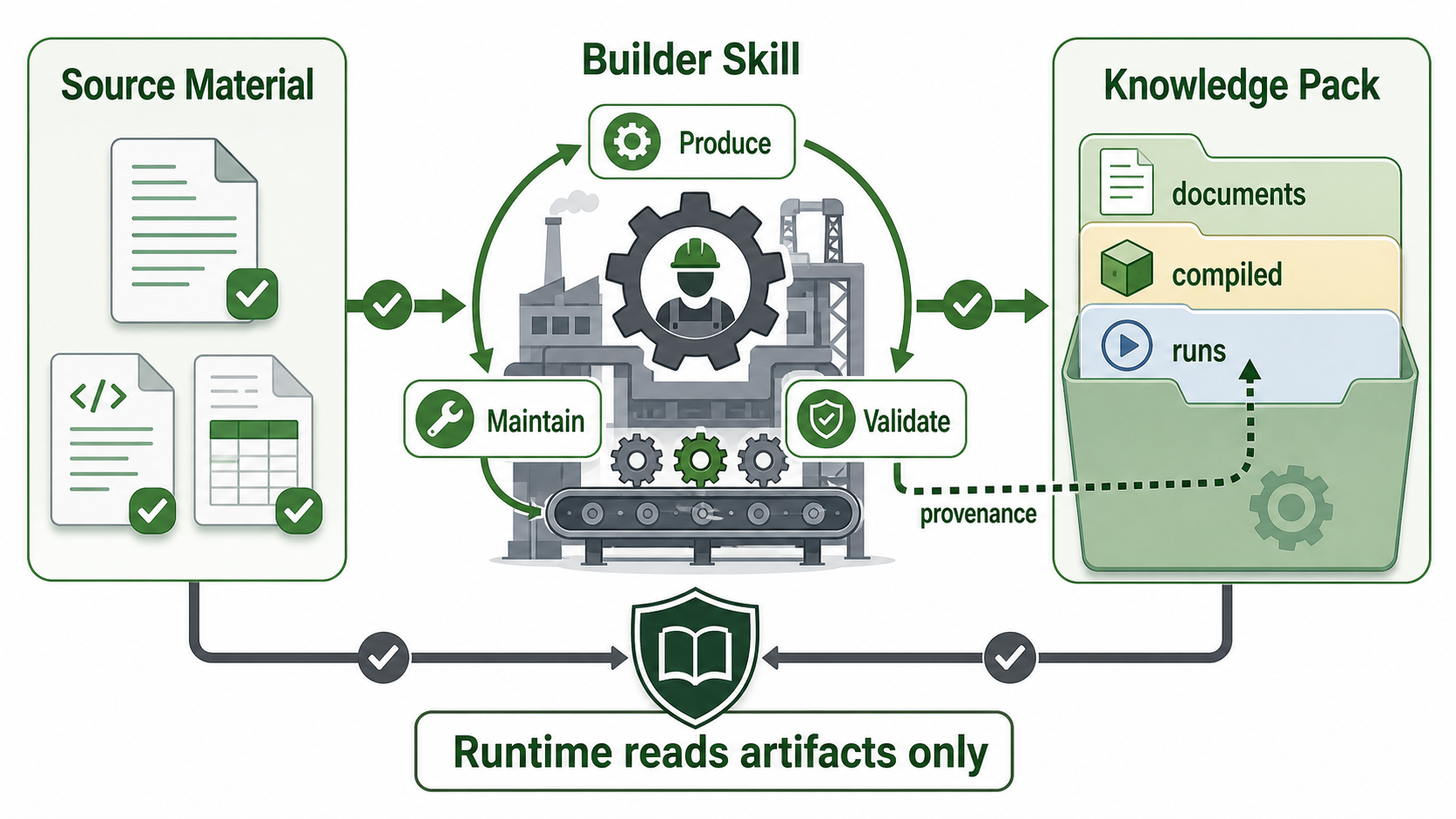
Builder Skill provenance
If a Knowledge pack is generated or maintained by a Skill, it SHOULD record provenance in KNOWLEDGE.md.metadata.producedBy and runs/compile-*.json:
metadata:
  primaryDocument: documents/main.md
  producedBy:
    kind: agent-skill
    name: personal-ip-knowledge-builder
    version: 1.0.0
digest: sha256:example{
"run_id": "compile-2026-05-07T10-00-00Z",
"trigger": "manual",
"status": "passed",
"profile": "document-first",
"builder_skill": {
"name": "personal-ip-knowledge-builder",
"version": "1.0.0",
"digest": "sha256:example"
},
"primary_document": "documents/main.md",
"inputs": [{ "path": "sources/interview.md" }],
"outputs": [{ "path": "documents/main.md", "operation": "updated" }]
}Provenance explains where the knowledge artifact came from. It does not mean the runtime should execute that Skill.
Companion Skill
We recommend capturing maintenance workflows in companion Skills such as:
personal-ip-knowledge-builderbrand-product-knowledge-buildercontent-operations-knowledge-builderprivate-domain-operations-knowledge-builderagent-knowledge-maintainer
These Skills can provide:
- creating a knowledge pack
- importing sources and normalizing metadata
- compiling
sources/ -> documents/ -> compiled/splits/orsources/ -> wiki/ -> compiled/ - running health, citation, and quality checks
- running discovery, context, and answer evals
- generating version snapshots and changelogs
These capabilities belong to the method layer and SHOULD live in a Skill, client command, CI, or external tool. The knowledge pack MAY store schemas, eval cases, run records, and sample data, but MUST NOT require clients to execute bundled scripts.
Script boundary
If a companion Skill uses scripts, scripts SHOULD follow the maintenance script contract:
- write operations support
--dry-run - output machine-readable JSON
- diagnostics go to stderr
- dependencies and runners are pinned
- network access and credential use are declared explicitly
A Knowledge runtime MUST NOT execute these scripts during discovery, activation, or context resolution.
What stays out of the pack core
The following MAY exist in Skills or toolchains, but MUST NOT become required Agent Knowledge protocol:
- a
scripts/directory - a specific LLM, editor, vector store, or graph database
- a specific package manager
- concrete importers, crawlers, or converters
- proprietary commands for one client
- full agent workflows or tool authorization policies
The portable Agent Knowledge unit remains a plain directory with Markdown and JSON artifacts.
Interop principles
- Agent Knowledge does not fork Agent Skills; it is a companion knowledge-asset standard in the same ecosystem.
- A Skill can write a knowledge pack, but a knowledge pack cannot require a client to execute a Skill.
- Skill output must leave
runs/records explaining what was read, what changed, and why review is needed. - The pack's
status,trust,grounding,profile, andruntime.moderemain determined by pack metadata and review results. - A client MAY call a maintenance Skill, but runtime answers SHOULD read maintained knowledge artifacts through a resolver.