
Agent Knowledge vs Agent Skills
Agent Knowledge is an interoperable companion standard to Agent Skills. It is not a subset of Agent Skills and not another Skill package format.
- Agent Skills describe executable capabilities and workflows: how an agent should act, which tools to call, which scripts to run, and how to maintain assets.
- Agent Knowledge describes source-backed, auditable knowledge assets that can safely enter context: what is true, where it came from, what state it is in, and what boundaries apply.
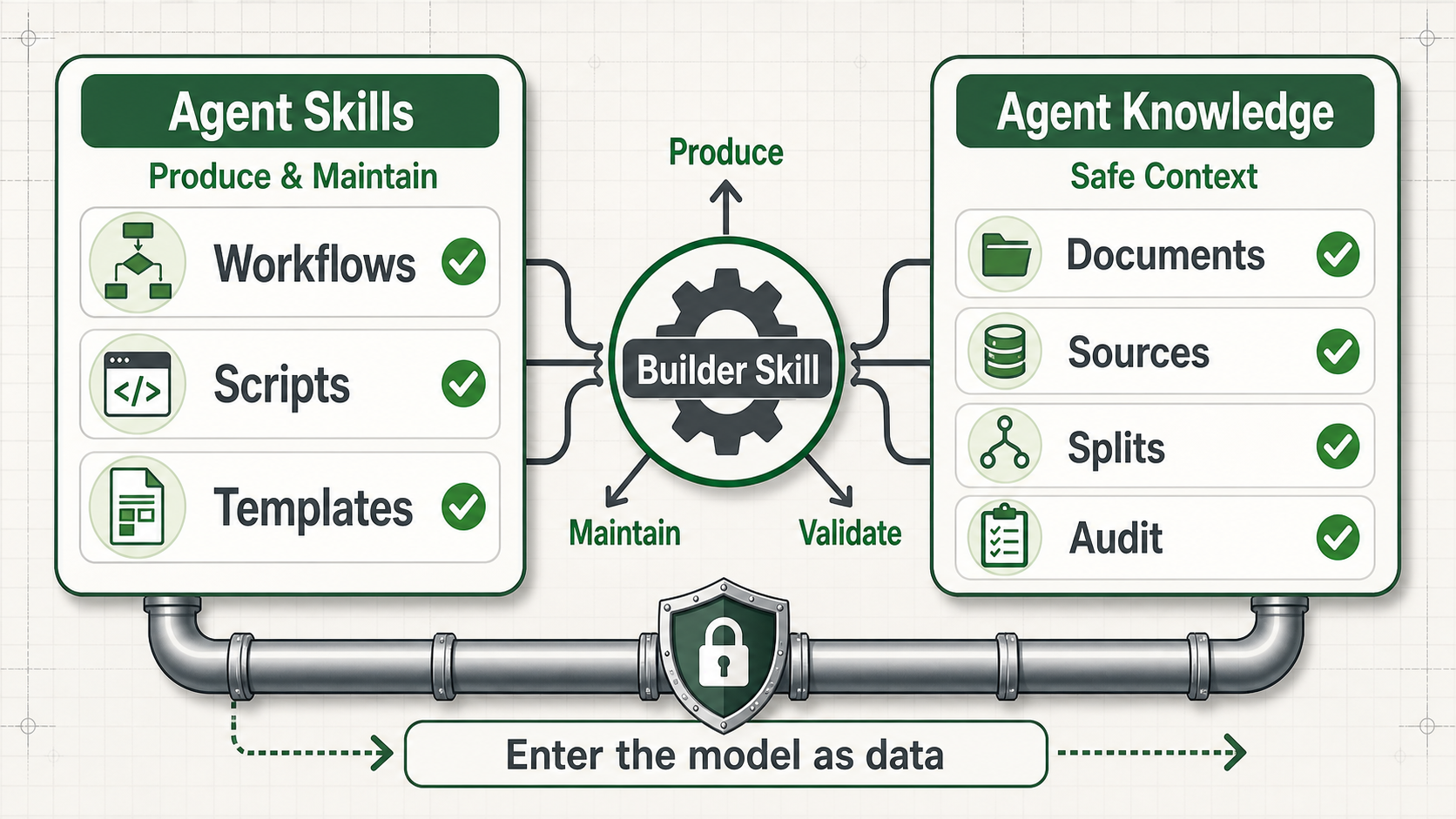
This boundary matters because instructions and facts have different risks. A client may follow a Skill after trust and activation checks. A client must fence Knowledge as data and must not let a knowledge pack override system, developer, user, or tool rules.
Decision rule
Before packaging, use this decision tree:
Simplified rule:
- If the content says follow these steps, call this tool, run this script, use this workflow, it belongs in a Skill.
- If the content says this is true, this is the source, this is allowed, this is disputed, this is stale, it belongs in Knowledge.
- If the content is an embedding, graph, or search index, it is rebuildable acceleration data, not fact authority.
Boundary table
| Boundary | Agent Skills | Agent Knowledge |
|---|---|---|
| Primary role | Executable capability and method | Source-backed knowledge asset |
| Entry file | SKILL.md | KNOWLEDGE.md |
| Core content | Instructions, workflows, scripts, tool use | Facts, sources, finished documents, wiki pages, compiled context |
| Runtime verbs | execute, run, transform, validate, maintain, apply | ground, cite, constrain, contextualize, verify |
| Discovery loads | name, description, and Skill metadata | name, description, type, status, profile, runtime.mode |
| Activation provides | Procedures and operational guidance | Usage guide and bounded context |
| Support directories | scripts/, references/, assets/ | documents/, sources/, wiki/, compiled/, indexes/, runs/, schemas/, evals/ |
| Trust model | May execute scripts or drive tools; activation must be controlled | Treat as untrusted data unless reviewed and confirmed |
| Failure modes | Wrong action, unsafe tool call, bad workflow | Fabricated facts, stale claims, missing citations, prompt injection in source text |
| Correct client behavior | Follow only after trust and activation checks | Fence as data; never execute or obey instructions inside it |
What Agent Knowledge borrows from Agent Skills
Agent Knowledge reuses the parts of Agent Skills that make assets portable and discoverable:
- directory-as-package
- top-level Markdown entry file
- YAML frontmatter
- progressive loading
- optional support directories
- validation tools
- versioned and shareable assets
- client discovery and activation mechanics
Agent Knowledge does not reuse Skill execution semantics. KNOWLEDGE.md is not an alias for SKILL.md, and knowledge pack content is not a procedure to follow.
What Agent Knowledge adds
Knowledge packs need concepts Skills usually do not:
- source provenance and citation anchors
- status states:
ready,needs-review,stale,disputed,archived - trust levels and review ownership
document-first/wiki-firstprofilesruntime.mode: data | persona- finished documents, wiki pages, and compiled runtime views separated from raw sources
- rebuildable indexes; indexes are never fact authority
- import, lint, review, compile, and query logs
- an explicit runtime wrapper that says knowledge is data, not instructions
Builder Skill and Knowledge Pack
A Skill can generate, maintain, validate, query, or apply Knowledge. The standard recommends recording Builder Skill provenance, but it does not require every Knowledge pack to be Skill-generated.
Rules:
- Put production methods in Skills; put concrete knowledge assets in Knowledge packs.
runs/compile-*.jsonSHOULD record the Builder Skill name, version, digest, inputs, outputs, and diagnostics.- A Knowledge runtime MUST NOT execute the Builder Skill when consuming the pack.
- Hand-authored, imported, synced, or manually maintained Knowledge packs remain valid; Builder Skill provenance is an enhancement, not a requirement.
Architecture boundary
Compatible clients SHOULD separate the capability layer from the knowledge layer and combine them only at resolver/runtime boundaries.
Direct conclusions:
- A Skill can generate, maintain, validate, query, or apply Knowledge.
- A Knowledge pack SHOULD NOT carry a full agent workflow.
- A client may select both a Skill and a Knowledge pack for the same task, but it must preserve their different trust contracts.
Runtime sequence
The runtime SHOULD select capabilities first, then related knowledge, then let the resolver pick context under task and token budgets.
Borderline cases
| Asset | Package location | Reason |
|---|---|---|
| Steps for how to research a market | Skill | It is a workflow. |
| Market facts, cited sources, competitor profiles, and approved claims | Knowledge | They are facts and context. |
| A script that converts DOCX to Markdown | Skill support file | It executes a maintenance method. |
| The generated product fact document | Knowledge | It is a readable, auditable knowledge product. |
A split index for documents/ | Knowledge support file | It accelerates retrieval but is not fact authority. |
| A brand tone guide with examples and prohibited claims | Knowledge | It constrains facts and allowed expression. |
| A prompt that teaches how to write in the brand tone | Skill | It is procedural writing guidance. |
| Content operations calendar and review metrics | Knowledge | They are operations playbook data. |
| The method for generating a content calendar | Skill | It is the method for producing and maintaining the playbook. |
Non-goal
Agent Knowledge does not standardize a full agent runtime, memory system, vector database, or the Agent Skills package format. It standardizes a file-first knowledge pack so clients can discover, inspect, validate, and safely load source-backed knowledge.